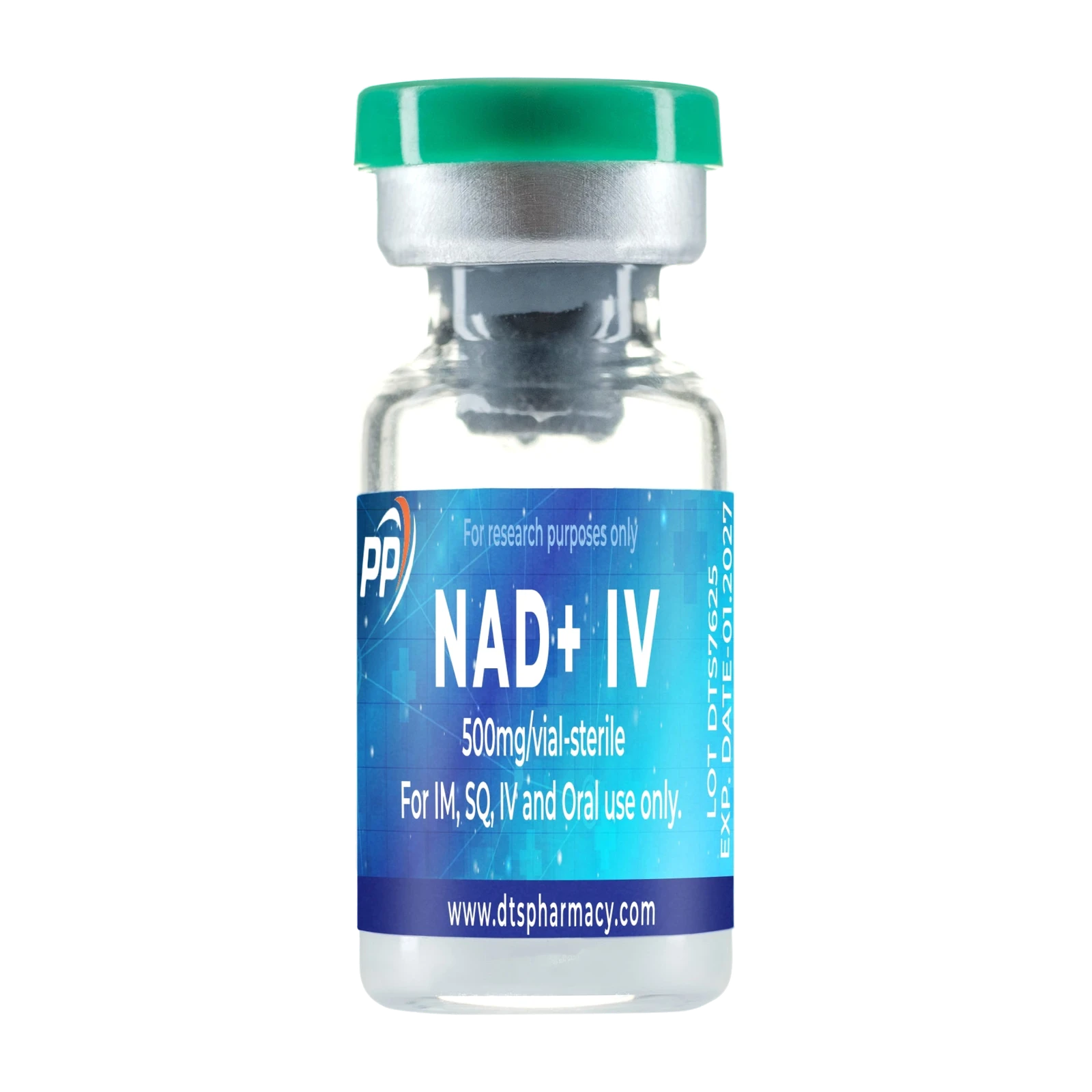
Vial
Research use onlyNAD+ (Nicotinamide Adenine Dinucleotide) - IV 200, 500mg
VAT included. Shipping calculated at checkout.
In stock
Secure delivery
Secure delivery with FedEx within 1–2 business days after payment confirmation
Payment methods
- Bank transfer
What is NAD+ (Nicotinamide Adenine Dinucleotide)?
NAD+ (Nicotinamide Adenine Dinucleotide) is a central cellular coenzyme involved in almost all of the essential biochemical processes linked to energy production and the maintenance of vital body functions. It is a molecule of fundamental importance for redox reactions, the synthesis of adenosine triphosphate (ATP), cell regulation and DNA repair.
Every cell depends on NAD+ to maintain its normal biological activity. As we age, natural NAD+ production declines, which can lead to lower mitochondrial efficiency, slower regeneration processes, fatigue, metabolic decline and changes in cognitive function. For this reason, NAD+ is one of the most intensively studied molecules in cellular ageing, longevity research and mitochondrial biology.
The intravenous form of NAD+ allows precise control of amount and concentration and enables researchers to observe dynamic changes in cellular energy, regeneration and metabolic responses. This method is particularly suitable for scientific studies in which maximum bioavailability and rapid uptake into the bloodstream are crucial.
What are the benefits of NAD+ (Nicotinamide Adenine Dinucleotide) as an intravenous infusion?
1. Restoration of cellular energy
IV infusions of NAD+ lead to a direct and immediate increase of the coenzyme in the bloodstream, which effectively supports mitochondrial function and therefore ATP production. This promotes optimal cell function and is particularly relevant in studies on fatigue, physical stress and metabolic disorders.
2. Support for metabolic processes and glucose balance
Scientific data show that NAD+ plays a key role in glucose oxidation, lipid metabolism and the regulation of insulin sensitivity. IV infusions make it possible to study these mechanisms under controlled conditions, for example in models of metabolic syndrome, diabetes or disturbed energy balance.
3. Cell regeneration and preservation of DNA integrity
NAD+ is required for the activity of PARP enzymes, which play an important role in DNA repair. Under conditions of cell damage or oxidative stress, the IV form allows the effect on repair mechanisms and the maintenance of genetic stability to be observed.
4. Mitochondrial biogenesis and stress resistance
In the scientific literature, NAD+ is closely linked to the activation of sirtuin enzymes, which regulate cell metabolism and the ability to cope with stress. Intravenous administration offers potential for studying the mechanisms of mitochondrial biogenesis, cellular ageing and regenerative signalling pathways.
5. Improvement of cognitive function and neuronal communication
Study reports suggest that NAD+ may support neuronal activity by optimising the energy balance in nerve tissue. The IV form provides rapid systemic availability, which is crucial in research protocols on brain function, memory and concentration.
6. Potential reduction of oxidative stress
Oxidative stress is closely linked to cellular ageing, inflammatory processes and metabolic disorders. NAD+ is a critical component of antioxidant systems and plays a role in neutralising free radicals. IV administration provides direct support for these protective mechanisms.
Mechanism of action of NAD+
NAD+ is actively involved in redox processes and acts as an electron carrier between the most important metabolic pathways: glycolysis, the citric acid cycle (Krebs cycle) and oxidative phosphorylation. This coenzyme is crucial for ATP synthesis and for maintaining the cellular redox balance.
Other key functions of NAD+ include:
- Activation of the sirtuin enzymes (SIRT1–SIRT7)
- Support for genomic stability through PARP enzymes
- Involvement in signalling pathways linked to cell survival
- Modulation of inflammatory responses
- Influence on mitochondrial efficiency and regeneration
The combination of these mechanisms makes NAD+ an important molecule in research areas such as cellular ageing, energy metabolism, neuroscience and regenerative medicine.
Correct use and dosage of NAD+ for intravenous use:
NAD+ therapy is adapted to the needs and physiological condition of the user.
Recommended use: 3–5 infusions within 7 days, starting with 100 mg; the dose per session can be increased to up to 500 mg, dissolved in 250–500 ml of infusion solution, depending on the amount of NAD+.
Maximum intravenous uptake: 100 mg of NAD+ per hour.
The therapy can be repeated after 5 weeks.
Possible side effects of NAD+ (Nicotinamide Adenine Dinucleotide):
IV administration of NAD+ may be associated with certain reactions described in the scientific literature. These are usually mild and short-lived and depend on the amount, the infusion rate and the body's individual response. Documented effects include:
- Slight sensation of warmth
- Feeling of tightness in the chest (temporary)
- Increased sensitivity or slight discomfort with faster infusion
- Headache
- Slight tiredness after the infusion
With correct monitoring and a controlled infusion rate, these effects are considered easy to manage. If it is administered too quickly, a feeling of tightness in the heart and chest area may occur, which is why the rate should be reduced to 30 drops per minute.